
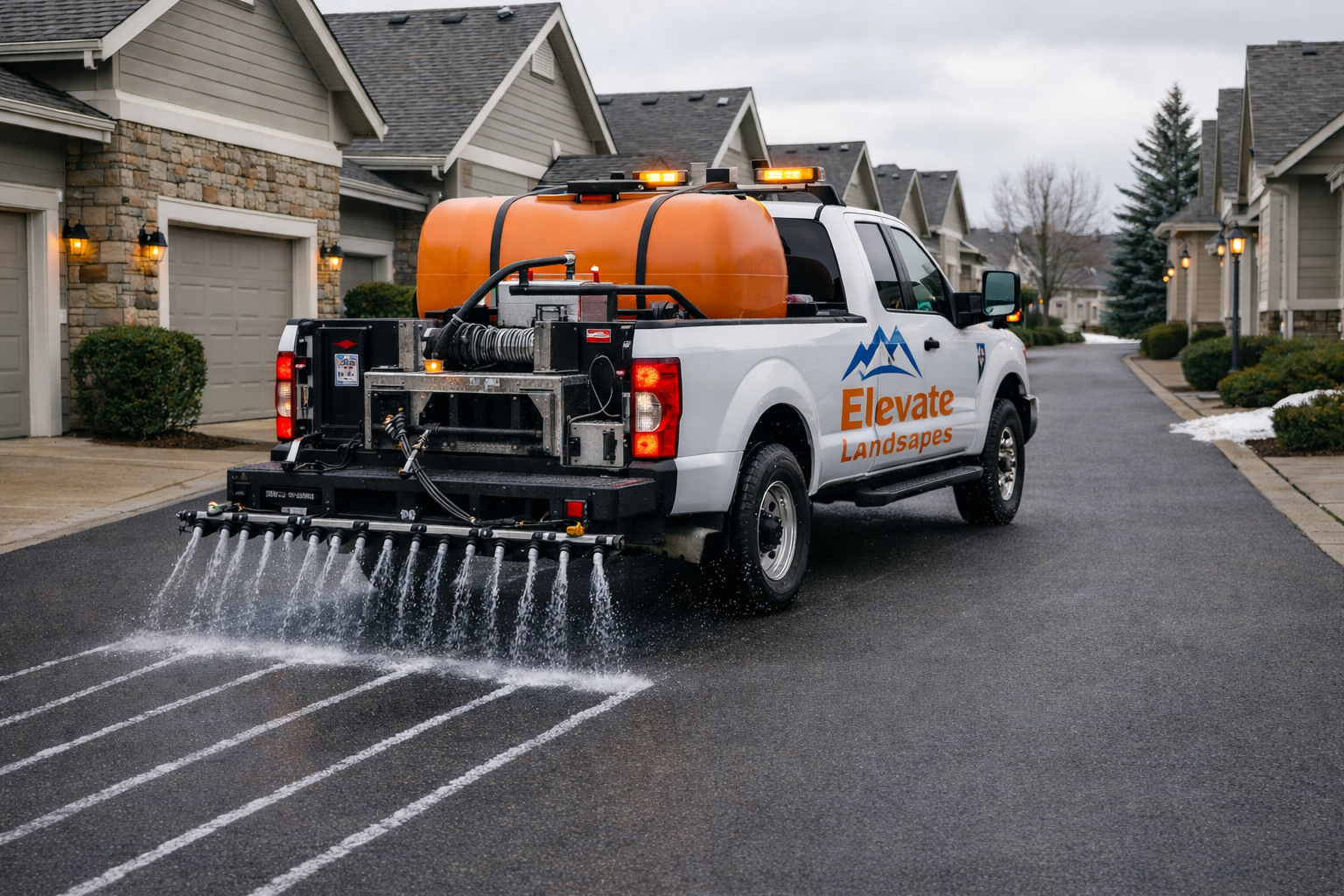
When snow is in the forecast, most property managers immediately think about plows, sidewalk crews, and ice melt. But some of the most effective snow and ice management begins before the first snowflake hits the pavement.
Liquid brine pretreatment, also known as anti-icing, gives commercial properties, HOAs, and multifamily communities another tool for managing winter conditions proactively instead of waiting for snow and ice to accumulate.
What Is Brine Pretreatment?
Brine is a liquid salt solution applied to pavement before a winter weather event. Once applied and allowed to dry, it leaves salt behind on the pavement surface.
The primary goal isn’t necessarily to melt an entire snowfall. Instead, brine helps prevent snow and ice from bonding tightly to pavement, making subsequent plowing and removal more effective.
This is the same basic anti-icing strategy used by transportation agencies throughout Colorado. CDOT describes anti-icing as a proactive treatment applied before storms to prevent snow and ice from bonding to road surfaces.
Why Pretreatment Matters in Colorado Springs
Colorado Springs presents some unique challenges for snow management. Sunshine, rapidly changing temperatures, elevation differences, wind, and freeze-thaw cycles can turn a relatively small storm into an ice-management problem.
A parking lot may look manageable immediately after snowfall, only for packed snow or melted runoff to refreeze as temperatures fall.
Pretreatment gives snow crews an advantage before that process begins.
1. It Helps Prevent a Hard Bond to Pavement
Once snow is driven over repeatedly or freezes directly to untreated pavement, mechanical removal becomes much more difficult.
Brine creates a treatment layer between the pavement and precipitation. That can help plows scrape surfaces cleaner and reduce the amount of bonded snow and ice left behind.
The City of Colorado Springs uses anti-icing on main streets when conditions permit for this same reason: preventing snow from bonding to pavement before accumulation begins.
2. It Can Improve the Effectiveness of Snow Removal
Plowing is still an essential part of managing significant accumulation. Brine does not replace a plow.
What it can do is make the plow more effective.
When less material is frozen to the pavement, crews may be able to achieve a cleaner scrape during the initial service. That can reduce the amount of hard-packed snow and ice that must be addressed later.
3. It Supports a More Proactive Ice-Management Program
Waiting until ice has already formed means crews are performing de-icing.
Applying material beforehand is anti-icing.
That distinction matters.
De-icing requires a product to work its way through existing snow or ice to break the bond with the pavement. Anti-icing is designed to help prevent that bond from developing in the first place.
For properties with early-morning resident traffic, employee arrivals, deliveries, school transportation, or other high-use periods, getting ahead of a storm can make a significant difference.
4. Liquid Application Provides Controlled Coverage
More material isn’t always better.
The City of Colorado Springs specifically cautions against over-application of deicing products because excessive salt can increase costs and contribute to pollution of local waterways.
A properly calibrated liquid application allows material to be distributed consistently across designated pavement areas rather than relying solely on granular products after conditions have deteriorated.
When Should Brine Be Applied?
Pretreatment isn’t appropriate for every storm.
Successful anti-icing depends on factors including:
- Pavement temperature
- Expected precipitation type
- Timing of the storm
- Air temperature and forecast temperature changes
- Existing pavement conditions
- The likelihood of rain preceding snow
- Expected accumulation
That is why brine service should be based on weather and pavement conditions, rather than simply applying it whenever snow appears in a forecast.
Even the City of Colorado Springs notes that weather conditions must be appropriate for anti-icing to be successful.
Brine Is One Part of a Complete Snow Management Strategy
There is no single product or service that eliminates winter risk.
A strong snow management program can include pretreatment, plowing, sidewalk clearing, de-icing, monitoring, and follow-up service for thaw-and-refreeze conditions.
Brine simply moves part of that strategy forward.
Instead of beginning the response after snow has already accumulated, pretreatment allows us to begin preparing the property before conditions deteriorate.
A Better Way to Prepare for the Next Storm
For HOA communities, multifamily properties, and commercial sites throughout Colorado Springs, snow management should be about more than reacting to accumulation. It should be about having a plan for the entire weather event.
At Elevate Landscapes, our goal is to help clients take a proactive approach to winter property management by using the right treatment, at the right time, for the conditions we’re expecting.
Interested in adding liquid brine pretreatment to your snow management program this winter? Contact us at 719-985-1421 today.
